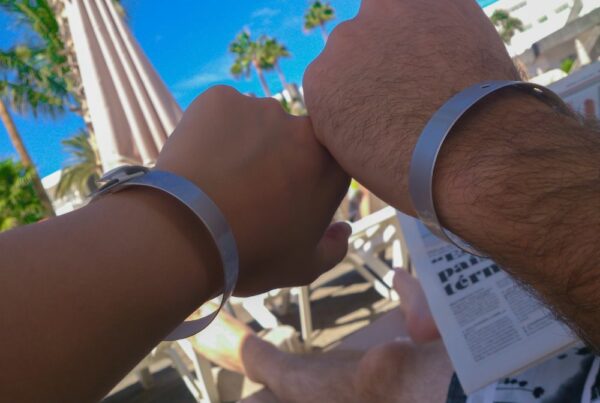

It’s 3 p.m. on a Tuesday in August. The pool deck at your resort is full. Your guest is in lounger 27, second day of his stay, sunglasses on, a paperback open on his stomach. He hasn’t checked a notification in three hours. That is exactly the experience he paid for.
A server walks past. Your guest waves him down. One Pacífico, please.
The server reaches for the POS terminal. Then he pauses. Your guest doesn’t have his wallet on him. The phone is upstairs, charging. There is a small operational decision to make, and nothing about the decision is your guest’s problem.
The server smiles and asks for the room number. He writes it down. The transaction is logged on paper.
That moment, repeated 800 times across your property on a busy day, is where the money goes.
The “Charge It to the Room” Tax
You probably don’t call it a tax. Most operators don’t. They call it a convenience, a hospitality standard, the way things have always been done in resorts. Fine. But every transaction that gets charged to the room without a verified credential is, mathematically, a dispute waiting to happen.
The numbers around this are not subtle. In the U.S., hotels account for roughly 55% of card fraud excluding friendly fraud, and friendly fraud now makes up about 71% of chargebacks labeled as fraud in the lodging sector (Prostay, 2026). The average chargeback value at a hotel sits around $200, well above the $120 travel industry average. A typical resort handling 50 disputes a year is looking at over $15,000 in direct costs before you count the operational tax: roughly $78 per dispute in average resolution time (Chargebacks911, 2025).
That last number is the one most operators underestimate.
A chargeback is not a billing event. It is an operations event that shows up in billing. Each dispute pulls reception, accounting, security camera review, and sometimes legal into a thirty-minute exercise to defend a $25 cocktail. Even after all that work, merchants win roughly 45% of contested chargebacks across industries; for fraud-coded disputes the win rate drops to about 17%. Net recovery, all in, sits near 18 cents on the dollar.
Translation: for every $100 your team chases, you keep $18. The other $82 is the cost of running a payment infrastructure that depends on a server writing a number on paper.
What You Lose Before You Lose the Dispute
The disputed transaction is the visible loss. The invisible loss is bigger.
Your server, at the moment of the order, has three options. He can ask the guest to walk back to the room for a card (this never happens). He can write the room number and trust the guest remembers the order at checkout (this is what happens). Or he can not approach the guest at all because the friction isn’t worth it (this happens more than you think).
That third option doesn’t show up anywhere. It is the second beer your guest didn’t order. The dessert that didn’t get suggested. The spa booking that the pool attendant didn’t bring up because handling the payment was going to be a hassle. Multiply by 400 rooms, 7 days, 3 outlets, and you get a department that doesn’t appear on any org chart.
Oracle Hospitality’s 2022 consumer research already showed where this is going: 49% of travelers want contactless payments, 39% want to order room service from their phone, and 39% want a fully contactless experience for all basic hotel transactions. Your guest is not asking for cashless. He is assuming it. The first time he has to wait for a server to come back with a paper slip, the assumption breaks. So does the trust.
The cost of inaction has three layers, all of them invisible until you go looking: chargeback exposure, lost ancillary sales, and the slow erosion of a guest experience that you marketed as effortless.
The Wristband Solves an Identity Problem, Not a Payment Problem
The mistake most operators make when evaluating cashless infrastructure is treating it as a payments upgrade. It isn’t. The payment is the easy part; Visa figured that one out in 1958. What your resort actually has is an identity problem.
Who is in lounger 27? Are they a registered guest? On what plan? What is their spending authority? Have they already disputed a charge this stay?
A POS terminal can answer none of those questions. A wallet can answer one. An NFC wristband linked to the guest’s PMS profile answers all of them, in a fraction of a second, with no friction visible to the guest. The wristband isn’t replacing the credit card. It is replacing the moment of doubt at the register.
This is what the cashless model actually solves. Not “faster payments.” Not “guest convenience.” It removes the transaction as a decision point. When the wristband is the wallet, the identity, and the room key, the question “how do I pay” never gets asked, because there is nothing to ask. The tap is the answer to a question no one had to formulate.
That changes the math at every point of sale in your resort. The server doesn’t write a room number. He taps. The bartender doesn’t decide whether to chase the second drink order. He pours it. The pool attendant doesn’t skip the upsell. He runs it.
When the Wristband Talks to a WebApp, the Pool Bar Becomes the Smallest Sale of the Day
The NFC wristband handles the in-person transaction. A guest WebApp handles every transaction that didn’t have a server in it.
Most guests have, at some point in their lives, ordered room service. Most of them have done it once and never again, because the workflow was built in 1987: pick up the in-room handset, find the menu in a binder, talk to a stranger, sort out the bill at checkout. Each step is a chance to give up. Most people give up.
Replace the binder with a progressive web app the guest opens from a QR code. Replace the phone call with a touchscreen the guest already owns. Replace the checkout reconciliation with a charge that posts straight to the folio.
Room service stops being a declining product. It starts being a mismanaged channel.
The same logic applies to activity bookings, spa reservations, restaurant tables, and any service your resort sells outside the room rate. The friction wasn’t demand. It was the channel.
You don’t need to wonder whether this works in practice. We have measured it.
The Pattern Krystal Cancún Made Visible
Krystal Cancún is a 502-room oceanfront property in the heart of Cancún. All-inclusive model, nine F&B outlets, six event venues. They deployed Goguest’s NFC wristband and WebApp platform with bidirectional PMS integration.
In the first six months of live operation, activity and service bookings through the WebApp rose 227%. Room service orders climbed 59%. Pool and beach towel loans, on a workflow no resort in the segment had ever bothered to digitize, jumped 514% (read the case study)
None of those numbers came from a new marketing campaign. They came from removing the friction that had been suppressing demand the resort already had. The guests wanted to spend. The infrastructure was getting in the way.
That is the entire argument in three numbers.
The Real Question for Your Property
You are not deciding between paper and plastic at the pool bar. You are deciding whether your resort runs an internal economy with verified identity at every transaction, or one where a server’s handwriting is the audit trail.
The first option captures every drink, every massage booking, every towel loan, every late-night room service order, on a single credential the guest doesn’t have to think about. The second option is what you have now.
The second beer is not a luxury. It is the most natural purchase your guest will make all day, in the most relaxed moment of his stay. The only thing standing between that purchase and your F&B revenue is the time it takes to handle it.
If you want to see what your property’s number looks like (where the invisible losses are, what an NFC and WebApp deployment would change about your F&B and ancillary capture), book 15 minutes with our team.
Book your 15-minute diagnostic session →
Sources
- Oracle Hospitality, Hospitality in 2025: Consumer Research Study, 2022. Link
- Chargeback Gurus in partnership with Juniper Research, State of Chargebacks in the Travel & Hospitality Industries Report, 2024.
- Chargebacks911, Chargeback Stats: All the Key Dispute Data Points, 2025–2026 edition.
- Sertifi, Hospitality Payment & Chargeback Statistics You Need to Know, citing Chargebacks911 and Forbes.
- Prostay, Hotel Chargeback: Causes and Best Practices, 2026.
- Hospitality Technology, Chargebacks for Cancellations at 49% in Hospitality, 2022.
- Goguest, Krystal Cancún Case Study, 2024.