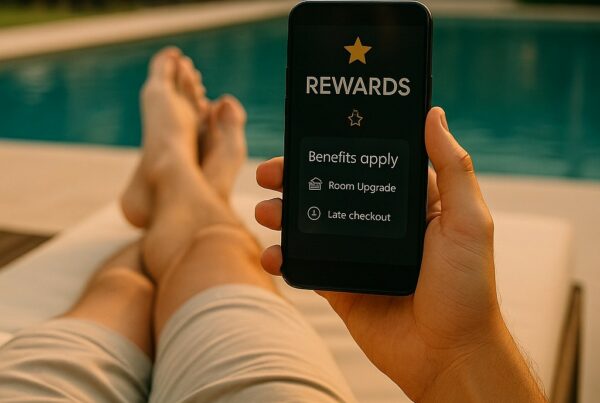

It is 7 in the evening at your resort. A guest is on the terrace of her suite, phone in hand. She opens the virtual concierge and types a simple question: Where should we have dinner tonight?, Somewhere good for a table of four?.
The answer comes back in seconds. Three restaurants on the property, each with a one-line reason why. It is written in her language. It is polite, fast, genuinely helpful. She is impressed.
Then she puts the phone down and calls the front desk to actually book the table.
The conversation worked perfectly. The transaction never happened. And that gap, repeated a few hundred times across a full house, is the part of the AI concierge story that no vendor demo will show you.
An AI virtual concierge is now the easy part
Let us be clear about something before going further: the move toward AI virtual concierges in luxury and resort hotels is real, and your guests want it. Oracle Hospitality’s “Hospitality in 2025” study, conducted with Skift, found that 74% of travelers want hotels to use AI to tailor their services and offers. Not a fringe preference. A clear majority, and a growing one.
So this is not an article about whether to adopt conversational AI. It is an article about a quieter and far more expensive question: what happens after the guest gets the perfect answer.
Here is what changed in the last two years. The conversation got cheap. An AI concierge that understands a guest, replies in nine languages and recommends the right restaurant is no longer a differentiator. It is close to a commodity. Any competent language model does it well.
What did not get cheap, and what no language model solves on its own, is everything that has to happen for that recommendation to become revenue.
A maître d’ with no kitchen
Most properties that add an AI concierge assume guest service is now handled. The assumption is understandable. It is also exactly where the money leaks.
An AI concierge that can hold a conversation but cannot complete a transaction is a maître d’ with no kitchen. He greets your guests beautifully. He knows the menu by heart. He takes the order with a smile. And then there is nowhere to send it.
In practice, the gap looks like this. The guest asks for an 8pm table. The AI recommends one. But the table is not actually held in the restaurant’s system, so the guest still has to confirm it somewhere else. The room service order is described, not placed. The spa slot is suggested, not reserved. The charge, when it happens at all, is not cleanly tied to the right guest folio, which is how disputes are quietly born weeks later at checkout.
Individually, none of those steps looks like a problem. Together, across a full property in high season, they are a steady leak of revenue you never captured. And the orders that do go through often only surface in a report after the fact, when the revenue conversation is already over.
The AI did its job. The system was never given one.
Conversation-grade is not transaction-grade
This is the distinction that matters, and it is worth naming clearly.
A conversational AI is conversation-grade. It is built to understand and to answer. That is genuinely useful, and it is also the part of the problem that is now solved. What a resort actually needs underneath it is transaction-grade infrastructure: the layer that turns a guest’s intent into a confirmed, billed, recorded action inside the systems you already run.
The conversation is the interface. The infrastructure is the operating system. One without the other is half a product.
So what does transaction-grade actually require? Three things. None of them glamorous. All of them load-bearing.
A place for the guest to act, not just ask. A guest-facing WebApp where the guest does not describe a room service order but places it; does not receive a restaurant suggestion but books the table; does not hear about the sunset catamaran but reserves two seats on it. No app to download. The conversation and the transaction live in the same place.
An identity behind every action. This is the part most easily overlooked and most quietly valuable. When every guest carries a verified NFC credential linked to their PMS profile, the system always knows precisely who is asking, which room, which folio. “A table for two at 8” stops being a vague request and becomes an action attached to a real, billable identity. That is also, not by coincidence, what makes chargeback disputes collapse: a charge tied to a physical credential the guest used is a charge that is very hard to dispute.
Integration with the systems of record. The request has to land somewhere real. A booking that never reaches Opera is not a booking. An order that never reaches the POS is not an order. The layer beneath the concierge has to integrate with the PMS and POS you already run, so the guest’s intent becomes a line item your team can actually see, fulfill and bill.
That is the half of the system that does not demo well. It is also the half that decides whether your AI concierge produces revenue or just produces pleasant conversations.
What happens when the transaction layer is in place
This is not theory. The difference is measurable, and it shows up fast.
When Krystal Cancún went live with Goguest, the property gave its guests exactly that transaction-grade layer: a way to order, book and reserve that was tied to a verified identity and wired into the operation. The result, in the first six months: room service orders up 59%, activity bookings up 227%.
Read those numbers slowly. Activity bookings did not improve. They more than tripled. Room service did not tick upward. It grew by well over half. And none of it came from a smarter conversation. It came from removing the friction between a guest wanting something and the system letting them have it.
The guests at Krystal Cancún were always willing to spend more. They were simply never given a frictionless way to do it. That is the entire game.
The question to ask before you buy
So when you evaluate an AI virtual concierge for your property, the question to put to the vendor is not how good the conversation is. Assume it is good. They all are now.
The question is what happens to the guest’s intent after the conversation ends. Where does the order go. Who is it billed to. Does it reach your PMS. Does anyone on your team ever see it.
An AI concierge that can talk but cannot transact is a maître d’ with no kitchen. The conversation was never the hard part. The transaction always was.
The AI is the easy part. The layer underneath it, the WebApp where guests act, the NFC identity that makes every action billable, the integration that lands it inside your systems, is what turns a pleasant guest experience into measurable revenue. That layer is what Goguest builds.
If you are mapping what a guest-facing layer should actually do at your property, before you commit to any concierge technology, that is a conversation worth having with the Goguest team.