



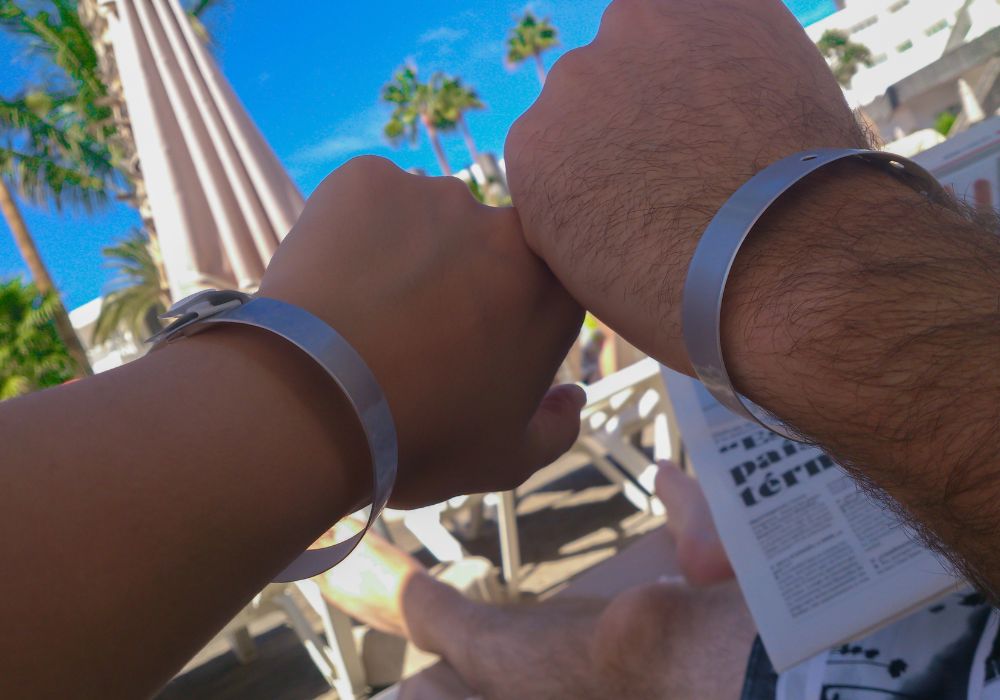

Wristband fraud is one of those revenue leaks nobody talks about in all-inclusive resorts: bands that get shared, reused and copied with nobody keeping count, legitimate guests who end up paying for mistakes they never made and a real cost that is almost always higher than what front desk and finance estimate. Here you will see how it happens, what it may be costing you every season and why the problem disappears the day every band becomes a verified credential.
There is a problem in all-inclusive resorts that almost never makes it into a management meeting: nobody knows how many wristbands are actually active on property at any given moment. Not roughly. Not at all. Bands get issued at check-in, and from that second on, most operations lose track of them. Some leave with the guest as souvenirs. Some get handed to a friend at the beach entrance. Some come back a season later, still the right color, on a wrist that never checked in.
Ask your front desk director how much money the property loses to wristband fraud in a year. Then ask your CFO. You will get two different numbers, and both will be guesses. That is the real problem. It is not that the fraud is enormous. It is that you cannot measure it, and what you cannot measure you cannot manage, price or fix.
If your only access control is a color on a wrist, your control is an opinion. And opinions do not show up in the P&L, but their cost does.
What wristband fraud actually looks like
Forget the movie version with sophisticated counterfeiters. Most of it is mundane, which is exactly why it goes unnoticed.
A guest checks out at noon and hands a still-intact band to someone in the parking lot. A visitor buys last season’s band online or keeps one from a previous stay; the color rotation repeats and nobody at the swim-up bar looks that closely. A standard-plan guest wears a premium-tier color that a family member left behind. A day-pass visitor stays three days on the same band because nothing on it says when it expires. And inside the operation, a bartender serves top-shelf pours against a band that identifies a category, not a person, so there is no record of who consumed what.
None of these incidents feels like a crime. Each one costs you a covered meal, a premium bottle, a spa slot or a full day pass. And an analog band cannot flag a single one of them, because a strip of colored silicone carries no identity, no expiry and no plan attached to it.
The guest pays for it too
It is tempting to read all of the above as a problem between your operation and the people gaming it. It is not. The analog band puts your legitimate guests at risk, and they are the ones writing your reviews.
Start at check-in. If your front desk hands out the wrong band by mistake, and with manual color systems it is a matter of time, the guest walks the property with an identity that is not theirs. Days later, when someone flags the mismatch or the audit catches consumption that the assigned plan did not cover, the guest faces surprise charges at checkout for services they used in good faith. They did nothing wrong. The band did. But they are the ones standing at the desk disputing a bill on the last morning of their vacation, and that is the moment they will remember when they rate the stay.
The tier colors create a second front. When gourmet restaurants, premium bars or adults-only areas hang on a color code, every faded band, every look-alike shade and every staff hesitation turns into a service denial. A guest who paid for the top tier and gets turned away at the door of the restaurant it includes will not blame the color chart. They will blame you, at the front desk first and online later. Complaints about services not delivered as promised are one of the most corrosive review patterns a resort can accumulate, and a good share of them trace back to a piece of plastic that could not prove what the guest had bought.
Wristband fraud costs you twice: once in what outsiders consume and once in what legitimate guests dispute, complain about and post.
Put a number on it, even a rough one
There are no reliable published statistics on wristband fraud in resorts. The vendors who sell bands quote figures, but none of them survive scrutiny, so we will not borrow them. What does exist is a broader benchmark: the Association of Certified Fraud Examiners estimates in its Occupational Fraud 2024 report, built on 1,921 real cases across 138 countries, that a typical organization loses around 5% of its revenue to fraud every year. Resorts are not exempt from that average. They just hide their share of it under the label of shrinkage.
So run your own arithmetic instead. This is an illustration, not a study, and you should replace every figure with your own. Take a resort where the day pass sells at USD 150. Suppose ten people per day get in on transferred, reused or copied bands and consume roughly what a day pass covers. That is USD 1,500 a day. Over a 120-day high season, USD 180,000 that your kitchens and bars produced and your revenue line never saw. Now change the assumptions: five people or twenty, USD 100 or USD 250. The order of magnitude survives every version of the exercise.
The uncomfortable part is not the estimate. It is that with analog bands you cannot even build the estimate, because there is no data to build it from.
Why analog fixes do not fix it
The traditional countermeasures are more colors, tighter closures and holograms. They all fail the same way: they make the band harder to fake but no easier to verify. Your staff still validates access at a glance, in two seconds, in a crowded pool area, against a color chart that changes weekly. The band still says nothing about who is wearing it, what their plan includes or whether their stay ended yesterday. You are asking a piece of plastic to do the job of a database.
What changes when the band becomes a credential
An NFC wristband is not a prettier band. It is a different object. It carries a unique identity linked to a real reservation in your PMS, and that changes the mechanics of every scenario above.
A transferred band stops working the moment its owner checks out, because deactivation is automatic. A souvenir band from last year is a dead chip, whatever its color. A premium-tier tap at the beach bar validates against the guest’s actual plan, so your bartender does not need to memorize anything; the reader answers in under a second. A lost band gets killed remotely and reissued without touching the guest’s balance. And every tap, at every outlet, leaves a record, which means that for the first time you can see consumption per credential and spot the anomalies that analog bands buried.
The guest side of the risk disappears with the same move. A credential linked to the reservation cannot be the wrong band, because the assignment is digital, not a color picked from a drawer. Access to the gourmet restaurant validates against what the guest actually purchased, so nobody paying for the top tier gets turned away by a hesitant glance. And since every consumption is on the record, checkout becomes a review of an itemized statement instead of an argument about charges nobody can trace. No surprise bills, no disputed mornings, no one-star goodbye.
There is a second layer most operators discover later: stock control of the bands themselves. When each unit has an identity, you know exactly how many credentials are active, how many are in inventory and how many never came back. In a single five-resort operation running on Goguest, more than 200,000 NFC wristbands and over 1.18 million assignments have been recorded, and the operators can answer at any moment the question this article opened with: how many bands are active right now, and who is wearing each one.
One clarification before you file this under all-inclusive problems: identification fraud is a plan-agnostic issue. NFC cashless works across every plan type. In all-inclusive the lead value is knowing who each guest is; in European Plan it is cashless payment without disputes; in both it is access that verifies itself.
The question worth asking
The question is not whether wristband fraud is happening at your property. It is. The question is whether you want to keep absorbing it as an invisible cost or turn every band on every wrist into a verified, auditable credential. If you want to see what that looks like on your own numbers, talk to us.